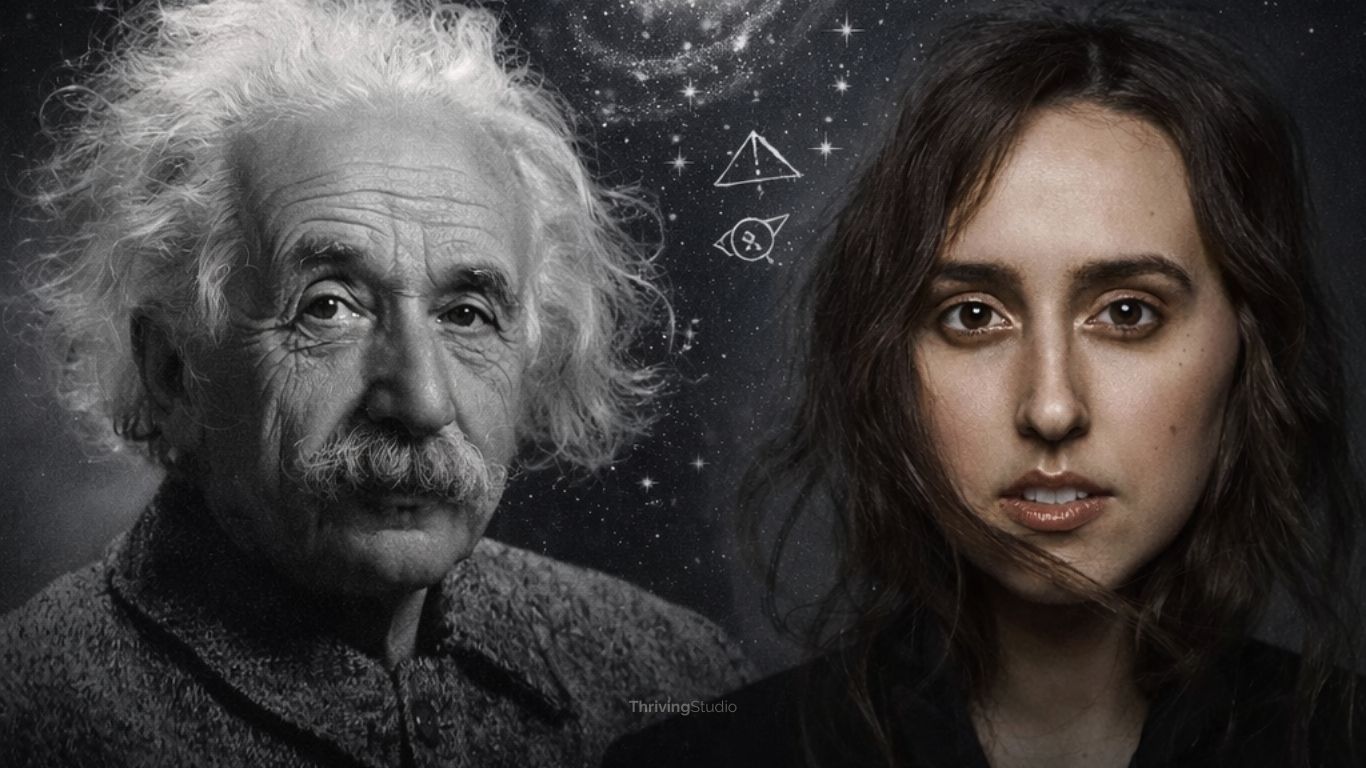
Why the “Next Einstein” Label Keeps Appearing With Sabrina Gonzalez Pasterski
Introduction
The phrase “the next Einstein” is usually empty.
It is often applied to young scientists as shorthand for intelligence, without regard for what they actually study or contribute. In most cases, the comparison fades quickly once attention moves on.
Yet one name continues to attract this label across media profiles, academic commentary, and online discussions: Sabrina Gonzalez Pasterski.
The persistence of the comparison suggests something more than momentary hype. To understand why it keeps resurfacing, it is necessary to look at her background, her research focus, and the specific traits that cause physicists to take notice.
Early Technical Ability, Not a Media Narrative
Pasterski’s early recognition did not begin with theoretical physics or press coverage. It began with engineering.
As a teenager, she designed, built, and flew a single-engine aircraft. This was not symbolic or experimental. The plane was functional, registered, and flown legally. That combination of mechanical competence and independent execution is uncommon and set the tone for how her abilities were perceived later.
What matters here is not novelty. It is evidence of early problem-solving skill and follow-through, traits that are difficult to manufacture through narrative alone.
Academic Trajectory and Training
Pasterski attended the Illinois Mathematics and Science Academy before enrolling at the Massachusetts Institute of Technology. She completed her undergraduate degree in physics in three years and graduated with a perfect departmental GPA.
She later earned a PhD in physics from Harvard University, working under Andrew Strominger, a leading figure in theoretical physics. Her doctoral work focused on symmetries in spacetime, quantum gravity, and related structures that sit at the edge of current physical understanding.
These are not fashionable topics chosen for attention. They are slow, abstract problems that attract only a small number of specialists and rarely produce immediate results.
The Nature of Her Research
Much of Pasterski’s work explores how gravity, quantum mechanics, and spacetime symmetries interact.
In practical terms, this means examining how information and structure might persist in gravitational systems, including black holes and gravitational waves. Her research contributes to areas such as celestial holography and the study of asymptotic symmetries, which attempt to describe the universe using boundary level information rather than conventional volume based models.
These subjects are technically demanding and progress incrementally. Recognition within them usually comes from clarity of thought rather than volume of output.
Why the Einstein Comparison Appears
The comparison to Einstein does not stem from a single discovery.
It appears because of a pattern. Early independent technical ability. Comfort with foundational questions. A tendency to work at the level of first principles rather than extensions of existing frameworks.
Einstein was not defined solely by intelligence, but by his willingness to question assumptions others accepted. Pasterski operates in a similar intellectual posture, focusing on unresolved structural issues in physics rather than refinements of settled theories.
This resemblance in approach is what fuels the comparison, not claims of equivalent achievement.
What the Label Gets Wrong
The phrase “next Einstein” implies replacement.
Science does not work that way. Modern physics is collaborative, distributed, and slow. No single individual reshapes the field alone, and no career can be evaluated before its trajectory is complete.
Applying the label too literally misrepresents both Einstein’s historical context and Pasterski’s actual position within contemporary research.
The comparison is better understood as shorthand for potential and orientation, not outcome.
Why Attention Continues
Pasterski’s career has progressed steadily rather than explosively. She has held research positions at leading institutions and contributed to specialized initiatives at the Perimeter Institute for Theoretical Physics.
Her work is cited, discussed, and debated within a narrow but influential community. That quiet persistence, rather than public visibility, is what keeps her name circulating among physicists.
Attention continues because the underlying signals remain consistent.
Conclusion
The “next Einstein” label persists around Sabrina Gonzalez Pasterski not because it is accurate, but because observers struggle to describe a familiar pattern using modern language.
That pattern includes early independent ability, focus on foundational problems, and resistance to superficial metrics of success.
Whether her work ultimately reshapes physics is unknown and impossible to predict. What can be said with confidence is that the comparison arises from substance rather than spectacle, and that alone makes it worth examining seriously.
Want More Practical Insights?
Get focused ideas on psychology, discipline, and creative growth delivered to your inbox.

Related Articles